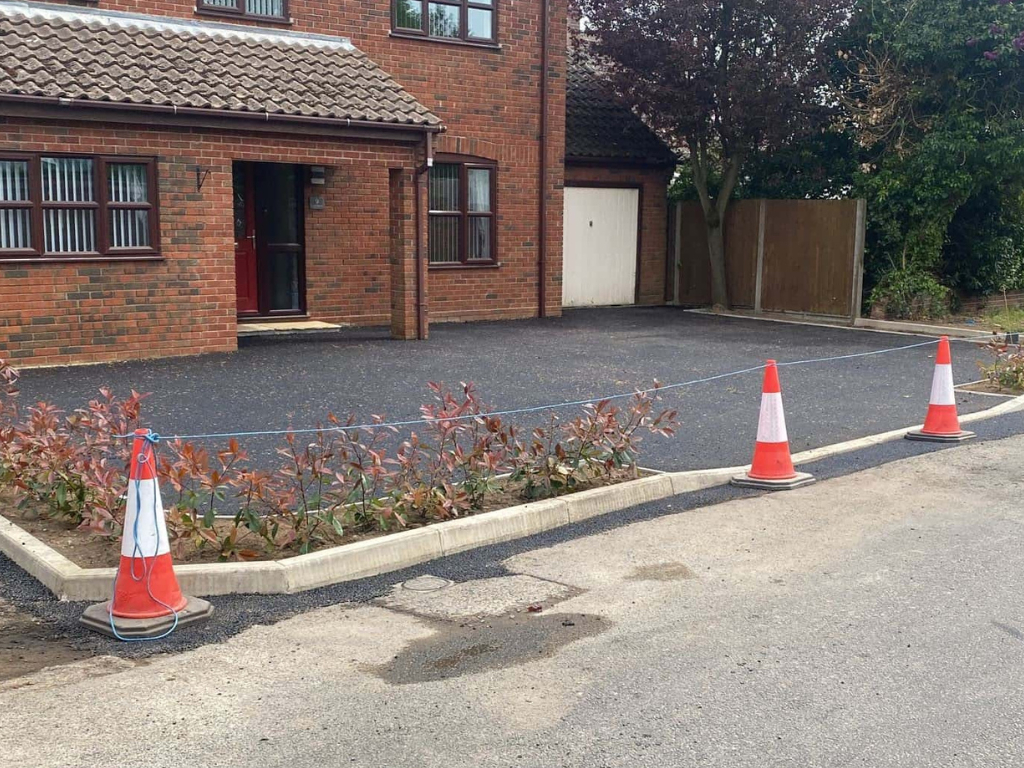
What Makes Tarmac Suitable for Both Residential and Commercial Surfaces?
Tarmac is widely used for driveways, access routes and other regularly travelled surfaces. Its versatility comes from more than its familiar appearance: when installed over a properly prepared base, it creates a continuous surface capable of accommodating frequent vehicle and pedestrian use.
Residential and commercial sites place different demands on their surfacing. A domestic driveway may support several daily vehicle movements, while a commercial area may experience heavier loads, turning traffic and sustained use. Tarmac can suit both environments when its design, foundation and installation are matched to the intended purpose.
Why Tarmac Works Across Different Types of Property
It Creates a Strong, Continuous Surface
Tarmac is laid and compacted to form a connected surface rather than a series of individual units. This helps distribute vehicle loads across the pavement structure and provides a stable finish for regular use.
For residential properties, this can create dependable parking and access. In commercial settings, the same principle can support busier traffic when the construction depth and supporting layers are designed appropriately.
The strength of the finished surface depends heavily on what lies beneath it. Tarmac cannot compensate for a weak or poorly compacted foundation.
The Construction Can Be Adapted to Its Use
Not every tarmac surface should be built in exactly the same way. The required excavation, sub-base depth and material specification depend on factors such as:
- Expected traffic levels
- Vehicle size and weight
- Existing ground conditions
- Drainage requirements
- Turning and braking areas
- The intended use of the site
A domestic driveway and a commercial access route may look similar at the surface, but their underlying construction may differ considerably. Professional assessment ensures that the complete structure reflects the loads it will carry.
It Provides a Smooth and Practical Finish
The continuous nature of tarmac creates a relatively even surface without joints between individual blocks. This makes it suitable for vehicle movements, pedestrian access and the movement of bins or other wheeled equipment.
A smooth finish can be useful for domestic driveways where convenient everyday access is important. On commercial premises, it can help create clearly defined routes that are practical for frequent use.
Correct laying and compaction are essential for achieving an even result. Poor workmanship can leave weak joints, rough sections or areas that hold water.
It Suits Both Small and Large Areas
Tarmac can be used across driveways of different sizes, as well as larger access and parking surfaces. Its method of installation makes it particularly effective where a consistent finish is required across a broad area.
On smaller properties, it can provide a simple surface that does not visually overwhelm the frontage. On larger commercial sites, it can create continuity between entrances, parking areas and circulation routes.
The layout should always be planned around the movement of vehicles rather than treating the space as one undivided surface.
It Can Accommodate Different Layouts
Properties often contain curves, changes in width, turning areas and connections to existing paths or entrances. Tarmac can be shaped around these features during installation.
This adaptability allows the surface to follow the practical layout of the site. Edging details can also help define its boundaries and provide support where vehicles may travel close to the perimeter.
Careful setting-out is particularly important around gates, entrances, drainage points and transitions to other surfaces.
It Performs Well Under Frequent Traffic
Tarmac has a degree of flexibility that allows it to accommodate normal movement within a properly constructed pavement. This makes it suitable for surfaces that receive repeated vehicle use.
However, areas exposed to stationary heavy loads, frequent turning or concentrated wheel movements need suitable structural preparation. Commercial performance depends on designing the surface for those demands rather than relying on the tarmac layer alone.
The same principle applies to busy domestic driveways, especially where several vehicles regularly use the same wheel paths.
Drainage Can Be Integrated Into the Design
Water is one of the main factors affecting the long-term performance of any surfaced area. If rainwater remains on the surface or penetrates weakened edges, it can contribute to deterioration within the supporting layers.
A professional tarmac installation should incorporate suitable falls and effective drainage routes. The design may need to account for:
- The direction of surface water
- Low points within the site
- Existing drainage features
- Connections with adjoining ground
- Areas where water currently collects
- The position of buildings and entrances
Effective drainage helps protect both residential driveways and larger commercial surfaces from avoidable water-related damage.
Localised Damage Can Often Be Addressed
Although all surfaces experience wear, some tarmac defects can be repaired when they are identified early and remain confined to a particular area. Cracks, edge deterioration or small failed sections may be suitable for targeted work.
The cause should be investigated before repairs begin. Damage may result from water ingress, base movement, inadequate edge support or loads that exceed the original construction.
Repairing only the visible surface without addressing the underlying weakness can allow the same problem to return.
It Has a Clean, Uncomplicated Appearance
Tarmac provides a uniform finish that can complement a wide range of residential and commercial properties. Its understated appearance allows entrances, landscaping and buildings to remain the main visual features.
Defined edging can introduce additional structure or provide a transition to lawns, paths and planted areas. On commercial sites, markings and designated zones can be incorporated where required for practical organisation.
A good result depends on neat boundaries, consistent compaction and carefully formed junctions.
Preparation Determines Long-Term Performance
The visible tarmac is only the upper part of the installation. Much of the surface’s reliability comes from excavation, sub-base preparation, compaction and drainage.
A professional installation should assess the existing ground, remove unsuitable material and create stable supporting layers. Particular attention should be given to soft areas, vehicle turning points and edges.
Skipping these stages may lead to sinking, cracking, rutting or surface breakup, regardless of whether the area is residential or commercial.
Conclusion
Tarmac is suitable for residential and commercial surfaces because it provides a smooth, continuous and adaptable finish. Its construction can be tailored to different traffic levels, layouts and vehicle loads, making it useful for both everyday driveways and busier access areas.
Its performance ultimately depends on correct preparation, effective drainage and professional installation. Eye Driveways & Surfacing provides tarmac surfacing solutions in Eye, Suffolk. If you are planning a residential or commercial surface, contact our team to arrange an assessment and discuss the most appropriate specification.
Call us on: 01379 778 393
Click here to find out more about Eye Driveways & Surfacing
Click here to complete our contact form and see how we can help with your driveway needs.